

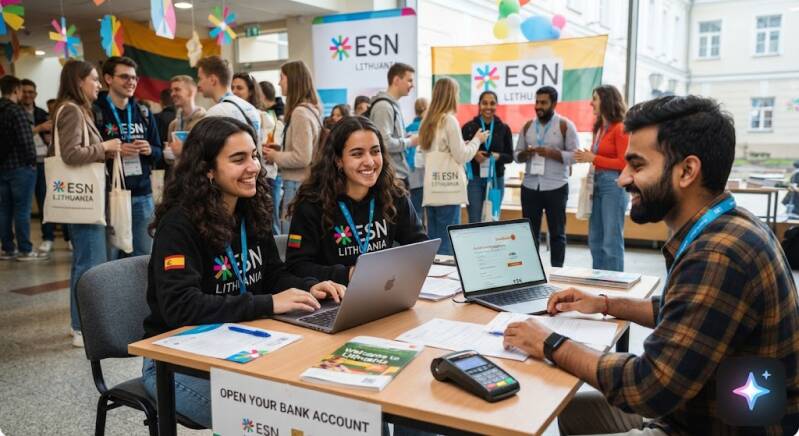
Open your Bank Account
Required for paying rent, utilities and receiving any student grants.
- Tip for Non-EU Students: Traditional banks like SEB or Swedbank charge high application fees for non-EU citizens (up to 250 EUR).
- Fintech solution: Open a free account online at Revolut Bank or Paysera in just 5 minutes, using only your passport and visa on your phone. After obtaining your residence permit (TRP), you can open an account at traditional banks for free.
Revolut Bank Lithuania
Revolut Bank UAB operates as a fully licensed official banking institution in Lithuania, being directly regulated by the Central Bank of Lithuania (Lietuvos bankas).
For international students, Revolut is often the first choice upon arrival. However, Non-EU student status brings a specific set of major advantages, but also some important administrative limitations.
Pros (Advantages for Non-EU Students)
- No Review Fees: Traditional Lithuanian banks (such as SEB or Swedbank) charge a Non-resident Compliance Fee that can reach up to EUR 200–250 for non-EU/EEA citizens. Revolut opens the account completely free of charge, eliminating this massive start-up cost.
- Fast Opening, Directly from Your Phone: You can open the account in just a few minutes using only your international passport and a valid National D Visa. You don't have to present a physical residence permit (TRP) from day one and there's no need to physically visit a bank branch.
- Local Account with Lithuanian (LT) IBAN: Being registered in Lithuania, Revolut gives you a current account number with the local LT prefix. This IBAN is instantly recognized by universities for transferring scholarships and is mandatory for direct payment of utilities in co-living complexes (SHED, Liv-in) or for collecting your salary if you get a job.
- Advantageous Currency Exchange: Non-EU students who receive money from home in other currencies (USD, CAD, INR, etc.) benefit from the interbank exchange rate offered by Revolut, saving considerable amounts compared to the high conversion fees applied by traditional banks.
- European Deposit Guarantee: Current accounts opened at Revolut Bank UAB are protected by the Lithuanian Deposit Guarantee Scheme, insuring funds held up to EUR 100,000 per customer, offering exactly the same safety standards as a traditional bank.
Disadvantages (Administrative Limitations)
- Security Blocks Upon Change of Residence: When a student changes their tax address from their home country to Lithuania or when their D Visa expires and uploads a new Temporary Residence Permit (TRP), Revolut’s automated compliance algorithms may trigger additional checks. This can sometimes result in the account being temporarily restricted until the documents are manually validated by support.
- Exclusively Digital Customer Support: Revolut does not have physical branches (agents) in Vilnius or Kaunas where you can go to talk directly to an operator in case of an urgent issue. All technical support is carried out via the in-app chat.
- Free Cash Withdrawal Limits: The Standard (free) plan allows you to withdraw cash from any local ATM without a fee up to a maximum of EUR 200 per month (or a maximum of 5 withdrawals). In Lithuania, although digital payments are ubiquitous, some traditional markets or small private services still require cash.
- Income Proof: Due to strict anti-money laundering (AML) regulations imposed by the Central Bank of Lithuania, if you receive large money transfers from parents or relatives outside the European banking network (SEPA), Revolut will temporarily block your transaction until you upload supporting documents (e.g. parent bank statements, donation documents or translated salary certificates).
HubStudentsEurope tips for proper use:
1. Use it as a launching pad: Open your Revolut account as soon as you have obtained your local phone number (prefix +370) to be able to manage your first weeks safely.
2. Migrate gradually after obtaining your TRP: Once you have received your physical residence card from the Migration Department MIGRIS and obtained your personal number code (asmens kodas), we recommend that you also open a free secondary account for young people at a major traditional bank Swedbank or SEB. This way, you will have total flexibility and zero risk of financial blockage.

Paysera Bank Lithuania
Paysera is a licensed, pioneering Electronic Money Institution (EMI), headquartered and fully regulated in Lithuania by the Bank of Lithuania (Lietuvos bankas).
For international students - especially non-EU citizens - Paysera is a massive lifesaver. It bridges the gap between digital ease and traditional banking convenience. Here's everything a student needs to know about it.
Pros (Advantages for non-EU students)
- No high compliance fees for non-residents: Unlike traditional Baltic banks that charge non-EU applicants around EUR 200-250 just to open and review a non-resident file, Paysera allows international students to sign up for a free account setup.
- A solid local Lithuanian (LT) IBAN: Like Revolut, Paysera gives you an official European bank account number that starts with LT. This makes it perfectly compatible for receiving university scholarships, paying rent at premium student housing configurations (such as SHED, Liv-in or Atlas Living) and setting up automatic payments of phone bills.
- Combination of web portal and mobile app: While Revolut is almost exclusively app-based, Paysera offers both a powerful mobile app and a fully functional e-banking interface for desktop web browsers. This makes it much easier to manage your finances, pay local utility bills or print official bank statements for MIGRIS immigration offices.
- Paysera Visa Card: You can order a physical Visa payment card directly to your student accommodation address. The card supports contactless payments, Apple Pay and Google Pay and is widely accepted at all retail outlets in the Baltics.
- Cheap international transfers: Paysera is globally renowned for its extremely competitive exchange rates and extremely low fees for sending money to non-EU home countries, making family financial support loops much cheaper.
Disadvantages and limitations
- Identity verification is done via video call: To ensure strict compliance with EU anti-money laundering (AML) laws, Paysera requires you to complete a live digital identification step (submitting your passport, Visa D or TRP and taking a live photo/video). If your internet connection is unstable or your documentation is unclear, the approval process could take several business days.
- Limited physical branches: Although Paysera has an official customer service center in Vilnius, it does not operate a traditional, extensive network of physical branches. Almost all of your interactions with customer service will take place digitally or by phone.
- Fees for specific local points of sale: While digital card payments are completely free, cash withdrawals from ATMs have a small fee, depending on the ATM network you use. Always check their pricing page to see the exact fixed monthly cash withdrawal limits.

AB SEB bankas
Is one of the largest, oldest, and most stable traditional retail banks in Lithuania, operating as part of the prominent Nordic financial services provider, the SEB Group.
While digital fintech platforms like Revolut or Paysera serve as perfect introductory launchpads, transitioning to an established institution like SEB offers maximum security and premium banking features once a student is fully settled in the Baltic region.
Advantages for Students
- Free Youth Plans (18–25): SEB offers highly competitive, specialized service plans tailored directly for students and young adults. These youth plans eliminate standard monthly maintenance fees and provide free daily banking services.
- The SEB Debit MasterCard: Students receive an official physical debit card that integrates seamlessly with Apple Pay, Google Pay, and the official SEB Mobile App.
- Massive Local ATM Network: Unlike fintech solutions that enforce strict monthly cash withdrawal caps, a traditional account with SEB provides much higher cash withdrawal limits across a vast network of physical ATMs throughout Vilnius, Kaunas, and Klaipėda.
- Advanced Authentication Tools: SEB is natively integrated with Smart-ID and Mobile-ID. This allows students to effortlessly sign official university contracts, log into the national MIGRIS migration portal or approve high-value transactions securely.
- Physical Branch Support: If a student encounters an issue or requires complex financial documentation (such as certified bank statements for visa extensions), they can book an in-person meeting at a brick-and-mortar branch to get manual support from an advisor.
Disadvantages & Entry Barriers
- The Non-Resident Compliance Fee: For non-EU/EEA students trying to apply before receiving their local residence card, SEB enforces a strict, non-refundable administrative verification fee that can go up to €200–€250. This fee is charged simply to process and review a non-resident application.
- Strict Onboarding Documentation: To open a traditional bank account, SEB requires solid proof of ties to Lithuania. Non-EU students must present their physical Temporary Residence Permit (TRP) card and their unique local personal code (asmens kodas).
- Appointment Hurdles: Traditional banking is rarely instant. To set up an account, students usually need to register for an online video consultation or book a physical branch slot well in advance.

Swedbank AB
Is the largest retail bank in Lithuania and a mainstay of the Baltic financial sector, operating as part of the prominent Swedish Swedbank Group.
It is widely considered the most popular traditional bank among local and international students, thanks to its unrivaled digital infrastructure and extensive network.
Pros (Student Benefits)
- “Youth Program” (Jaunimo Programa): Swedbank offers specialized accounts for students and young adults (under 26), which are completely free of monthly maintenance fees.
- Most popular banking app: Swedbank’s mobile app is consistently rated as the most intuitive in the Baltics, offering hassle-free budgeting tools, instant peer-to-peer payments via phone number, and full compatibility with Apple Pay, Google Pay, and Garmin/Fitbit contactless payment.
- Unparalleled ATM and branch footprint: Swedbank has the most extensive physical infrastructure in Lithuania. You can find Swedbank ATMs and branches on almost every corner of Vilnius, Kaunas and Klaipėda, making cash management effortless.
- Seamless Smart-ID integration: As a leading partner of the Smart-ID framework, Swedbank allows students to authenticate their identity instantly. This makes it incredibly easy to securely log in to university student portals, sign lease agreements or access the national migration platform MIGRIS (https://www.migracija.lt/).
- Dedicated English support: Their phone banking and branch staff are highly qualified to provide support to international students fully in English.
Disadvantages (Cons and barriers to entry)
- High verification fees for non-residents: If you are a student from outside the EU/EEA and try to open an account before your official residence card arrives, Swedbank charges a substantial, non-refundable registration fee (usually around EUR 200). This fee covers the compliance checks required for non-residents.
- Proof of local residency required: To avoid the compliance fee and open a free account under the Youth Programme, international students must present their physical Temporary Residence Permit (TRP) card and Lithuanian unique personal code (asmens kodas).
- Mandatory prior appointment: You cannot simply walk into a Swedbank branch and open an account on the spot. Due to high demand, you must register online in advance for a spot in a physical branch or for a digital onboarding consultation.
