

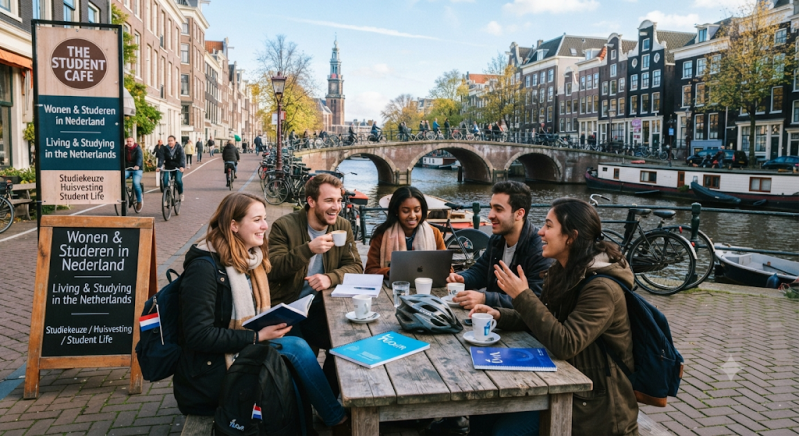
Welcome to the Netherlands.
The Netherlands is full of tulips, windmills and picturesque canals, but it also has a complex bureaucratic system for international students. HubStudentsEurope helps you navigate quickly through documents, accommodation and permits. Turn paperwork into simple formalities and enjoy student life in the Netherlands!
The Roadmap: How to get settled in 6 steps.
1. Housing, Registration & Phone Number: Finding a studio can be difficult due to high demand, so start early on platforms like Kamernet or Room.nl. After you move, you need to register your address with your local municipality (Gemeente) to receive a BSN (Citizen Service Number).
The next step is to get a Dutch phone number, which is required to get a DigiD (Digital Identity).
DigiD (Digital Identity): This is your most important asset in the Netherlands. It is the digital key you use to log in to government websites, insurance portals, and universities.
- Non-EU Crucial Tip: Your Gemeente appointment requires a valid passport with your MVV/IND provisional visa and your rental contract.
- Connectivity Solution: Avoid local, in-person, only SIM card issues by activating an eSIM before departure.
Get your Airalo Netherlands eSIM here
2. Banking: You will need a Dutch bank account (IBAN) to pay rent, receive a salary, or set up automated payments for your utilities. Banks like ING or Bunq are popular choices for international students due to their English-friendly mobile apps.
- Non-EU Crucial Tip: Traditional banks require a BSN to open an account. To pay rent immediately, use a digital bank like Bunq that accepts a non-EU passport before a BSN is issued.
3. Dutch Government Benefits for Students: If you are a student in the Netherlands, you may be eligible for financial support to help cover your living expenses.
- Non-EU Crucial Tip: Non-EU students can apply for Zorgtoeslag (Healthcare) and Huurtoeslag (Housing). Note: Zorgtoeslag requires a Dutch public basic health insurance policy, which is only obtainable if you are employed.
4. Health Insurance: In the Netherlands, basic health insurance is mandatory for everyone living and working there. Make sure to compare providers as soon as you arrive.
- THE NON-EU HEALTH INSURANCE LAW: If you are a Non-EU student not working, you are forbidden from having Dutch public health insurance and must use a private international policy.
- The Workplace Exception: Once you start a part-time job or paid internship, you must immediately switch to a Dutch public basic health insurance plan. Compare Private & Visa-Compliant Student Plans via HelloSafe
5. Transportation (The Bicycle Culture): A bicycle is not just for recreation in the Netherlands; it is your primary mode of daily transport. Visit a local shop or look for second-hand deals to get your own bike immediately.
6. Social Integration: Join student associations or sports clubs at your university to connect with both local and international students. Building a social circle early on will make your transition much smoother.
- Non-EU Crucial Tip (Working Rights): You are limited to 16 hours/week during the semester, and your employer must obtain a TWV work permit for you.
-Daily Life & Essentials: Moving to a new country comes with a host of practical needs for everyday life. From essential pharmaceuticals and personal care items to seasonal clothes and university outfits, you can get everything quickly and online, with delivery directly to your new address.
First step
Housing , BSN Registration, Phone Number & DigiD (Digital Identity)
Your Essential Dutch IDs: BSN & DigiD
To navigate life in the Netherlands, you must prioritize these two key identifiers:
Connectivity
A fast and stable internet connection solution, extremely useful for international students in the first weeks after arrival. Airalo's eSIM data package for the Netherlands is officially called Keukenhof.
Network and Connectivity in the Netherlands:
- Local Operators: Airalo dual-connects to the KPN and Vodafone NL networks. Both are top-tier networks in the Netherlands, offering excellent stability.
- Speeds and Coverage: Enjoy 4G LTE and 5G speeds (5G coverage is almost ubiquitous in university centers such as Amsterdam, Rotterdam, Utrecht, Groningen or Eindhoven).
- Data Sharing: Mobile Hotspot (tethering) is fully allowed.
- Plan Type: This is a data-only package. It does not include a local phone number (+31).
A. BSN (Burgerservicenummer):
This is your unique personal citizen service number. It is the foundation for everything in the Netherlands; without it, you cannot legally work, open a bank account, or obtain health insurance. You receive your BSN automatically after registering your address at your local municipality (Gemeente).
If you are moving for studies (more than 4 months), you are legally obliged to register in the population database (BRP - Basisregistratie Personen) within 5 days of arrival.
Step I: Find a place to live. You need an official address where the owner explicitly allows you to register (inschrijving).
Step II: Make an appointment at the town hall. Contact the town hall (Gemeente) of the town where you will live. Ask for an appointment for the “first registration” (eerstelingsvestiging or first registration).
Step III: Prepare your file. Take with you: Identity document (Passport or EU ID card (if you are an EU citizen), in original). Rental contract (huurcontract) or a written and signed statement from the owner confirming that you live there. Translated and legalized birth certificate (European standard format without translation).
Step IV: Go to the town hall, you must be physically present at the appointment.
Step V: Wait for the letter. The town hall will send you the confirmation of registration and your BSN code by mail. This can take from a few days to 3-4 weeks.
Step VI:To be able to connect to the Dutch state you need a Dutch phone number.
The best recommendation is Prepaid cards – The easiest upon arrival
They do not require a bank account or BSN. You buy them on the spot in the supermarket.
Lebara: The most expat-friendly. The website and support are completely in English, it has excellent coverage (KPN network) and cheap options for international calls.
AH Mobiel (Albert Heijn): Very affordable. You buy the card directly at the cash register in the most popular Dutch supermarket and easily reload it via the app.
B. DigiD (Digital Identity):
This acts as your secure digital key to access all Dutch government services online. You can only apply for a DigiD once you have your BSN and are officially registered in the municipal database. You can activate it by mail or, for a faster process, by scanning your passport/ID using the DigiD app.
Pro Tip: Register with your local municipality as a priority upon arrival. Everything else, from healthcare to banking, depends entirely on having your BSN in hand, as well as your Dutch phone number, without which you cannot contact the Dutch state.
Connectivity
A fast and stable internet connection solution, extremely useful for international students in the first weeks after arrival. Airalo's eSIM data package for the Netherlands is officially called Keukenhof.
Network and Connectivity in the Netherlands:
- Local Operators: Airalo dual-connects to the KPN and Vodafone NL networks. Both are top-tier networks in the Netherlands, offering excellent stability.
- Speeds and Coverage: Enjoy 4G LTE and 5G speeds (5G coverage is almost ubiquitous in university centers such as Amsterdam, Rotterdam, Utrecht, Groningen or Eindhoven).
- Data Sharing: Mobile Hotspot (tethering) is fully allowed.
- Plan Type: This is a data-only package. It does not include a local phone number (+31).

Finding Student Housing: Essential Guide
Finding a place to live is your first priority. Use these reliable platforms to start your search:
- Kamernet: The most popular platform for finding rooms in shared apartments.
- Room.nl: A dedicated housing platform specifically for students, especially useful in major university cities.
- HousingAnywhere: An international platform that is ideal for foreign students looking for accommodation before arriving in the Netherlands.
- Funda.nl: The primary real estate portal in the Netherlands, best suited if you are searching for entire apartments or studios.
Golden Rules for Your Safety
To avoid scams and ensure your stay is legal, keep these critical tips in mind:
- Confirm Registration Rights: Always ask the landlord if you can perform an inschrijving (registration at the municipality) at that address. If you cannot register, you will not be able to obtain your BSN.
- Avoid Advance Payments: Do not transfer money before viewing the property or signing a legal contract.
- Secure a Written Contract: Always ensure you have a signed, written rental contract. This document is mandatory for your registration at the town hall to obtain your BSN.
HOUSING
Kamernet
Kamernet is one of the most well-known and widely used platforms for finding student housing in the Netherlands. It specializes in connecting people looking for a place to live with landlords or current tenants who have rooms, studios, or apartments available.
Key Features of Kamernet:
Target Audience: It is particularly popular among students and young professionals who are searching for rooms in shared houses or apartments.
Search Filters: The platform allows you to filter listings based on your preferences, such as city, budget, size, and whether the room is furnished or unfurnished.
Legitimacy: While it is a major player in the Dutch rental market, always remember the "golden rule": verify that the landlord allows official registration (inschrijving) at the address before committing.

Room.nl
Room.nl is a specialized platform primarily focused on student housing in the Netherlands. It serves as a central hub where various housing associations list available rooms for students.
Key Features of Room.nl:
- Student-Focused: The platform is specifically designed to help students find suitable accommodation in major Dutch university cities.
- Housing Associations: It aggregates listings from multiple housing associations, which often makes it a reliable source for student-specific rentals.
- Registration System: Unlike typical classified sites, Room.nl often functions on a registration basis where you build up "registration time" to increase your chances of securing a room.

HousingAnywhere
HousingAnywhere is a prominent international housing platform that connects students and young professionals with landlords and property managers across Europe, with a very strong presence in the Netherlands.
Key Features of HousingAnywhere:
- International Focus: It is specifically designed for international students, making it easier to book accommodation before you even arrive in the country.
- Secure Booking: The platform uses a secure payment system where the first month's rent is held by HousingAnywhere and only transferred to the landlord 48 hours after you move in, helping to protect you from scams.
- Verified Listings: Many listings on the platform are verified, which adds an extra layer of security for users searching from abroad.

Funda.nl
Funda.nl is the primary real estate portal in the Netherlands. It is the most comprehensive platform used by locals and expats alike for finding houses, apartments, and studios across the country.
Key Features of Funda.nl:
- Comprehensive Listings: It hosts the vast majority of rental and purchase properties available in the Dutch market.
- Best for Apartments: It is particularly well-suited if you are searching for entire apartments or studios rather than just single rooms in shared housing.
- Reliability: As the leading real estate portal in the Netherlands, it is a highly trusted resource.

Duch Phone Number
Lebara
Lebara: The most expat-friendly. The website and support are completely in English, it has excellent coverage (KPN network) and cheap options for international calls.
Important for DigiD: In the Netherlands, you absolutely need a local phone number to receive security SMS from the government. Order a free SIM card from Lebara – it is the most popular operator among international students and offers flexible prepaid options

AH Mobiel (Albert Heijn)
AH Mobiel (Albert Heijn): Very affordable. You buy the card directly at the cash register in the most popular Dutch supermarket and easily reload it via the app.

DigiD (Digital Identity)
DigiD (Digital Identity): This acts as your secure digital key to access all Dutch government services online.


Second step
Banking
Banking in the Netherlands: Essential Guide
Opening a Dutch bank account is vital for managing your daily expenses, paying rent, and receiving your salary.
Recommended Banking Options
- Traditional Dutch Banks (ING, ABN AMRO, Rabobank): These are the most reliable choices for long-term stays.
- Bunq: Great for immediate needs.
- Bunq: A Dutch-licensed bank that is very friendly to expats and often allows you to open an account quickly, sometimes even before you have your BSN.
Key Tips for Success
- The Maestro/V-Pay Factor: Many Dutch shops and supermarkets, such as Albert Heijn, exclusively accept local debit cards (Maestro or V-Pay).
- BSN Requirement: While some digital banks are flexible, traditional banks will require your BSN to open a full account.
- Look for Student Offers: Most major banks offer "Student Accounts" with lower monthly fees, so be sure to check for these when signing up.
ING Netherlands: Traditional Banking
ING is one of the largest and most reliable traditional banks in the Netherlands. It is a popular choice for students due to its widespread presence and robust digital infrastructure.
- Reliability & Trust: As a major traditional Dutch bank, ING is fully accepted by all government services, employers, and utility providers.
- Student Accounts: They offer specific student-friendly accounts, which typically come with reduced monthly fees and digital tools to manage your finances easily.
- Full Integration: Having an account with a traditional bank like ING ensures you have the necessary local IBAN (starting with NL) required for official registrations and receiving salary payments.
- Accessibility: They have numerous physical branches and ATMs across the country, which is helpful if you prefer face-to-face service or need assistance with your account.

ABN AMRO: Traditional Banking
ABN AMRO is one of the three major Dutch banks, known for its strong reputation and comprehensive financial services. It is an excellent choice for students who prefer a traditional, stable banking partner.
- Reliability & Integration: As a top-tier traditional bank, ABN AMRO is fully recognized by all Dutch government institutions and employers.
- Student Accounts: They offer dedicated banking packages for students, providing essential features like a debit card and mobile app at a competitive monthly rate.
- Local Banking Standards: Like other traditional banks, providing a BSN (which you receive after your municipality registration) is required to open a full account, ensuring you have the necessary local IBAN (NL) for all administrative tasks.
- Support & Presence: The bank maintains a wide network of ATMs and professional customer support, offering peace of mind if you need assistance during your studies.

Rabobank: Traditional Banking
Rabobank is the third major Dutch bank, widely recognized for its extensive national network and deep roots in the Dutch community. It is a highly reliable choice for students who value stability and accessibility.
- Reliability & Full Support: As a leading traditional bank, Rabobank is fully accepted by all government services and local institutions.
- Student Accounts: They provide specialized student banking services designed to help manage personal finances with lower costs and easy-to-use mobile tools.
- Official Compliance: To unlock the full functionality of your account and obtain the necessary local IBAN (starting with NL), you will need to provide your BSN after completing your municipal registration.
-National Presence: With one of the largest networks of branches and ATMs in the Netherlands, it is a very convenient option for those who may need in-person assistance.

Bunq: The Digital Alternative
Bunq is a fully licensed Dutch bank that offers a digital-first experience. It is a highly popular choice for international students because it allows you to open an account quickly, often before you have your BSN, while still providing all the features of a traditional local bank.
- Official Recognition: As a bank with a full Dutch license, Bunq is accepted by Dutch government institutions and systems, allowing for seamless integration with services like DigiD.
-Local IBAN: You receive an IBAN starting with NL, which is essential for receiving salary payments and paying rent or bills within the Netherlands.
- Online Convenience: The account opening process is 100% online, making it a faster alternative to traditional banks that may require physical branch appointments.
- Ideal for Expats: It is specifically designed to be friendly to newcomers in the Netherlands who need to get their finances in order immediately upon arrival.
Please note: To activate your DigiD electronic identity or to receive your rent allowance from the state, standard international banks are not accepted by the Dutch authorities. We recommend Bunq (The Free Bank). It is an official Dutch bank, gives you an instant Dutch (NL) IBAN and integrates natively with government systems.
Third step
Dutch Government Benefits for Students
If you are a student in the Netherlands, you may be eligible for financial support to help cover your living expenses.
- Zorgtoeslag (Healthcare Allowance): This is a monthly allowance provided by the government to help cover the costs of mandatory Dutch health insurance. Eligibility is based on your income and assets, and most students with low or no income qualify for a significant portion of their insurance costs to be covered. You must have a Dutch health insurance policy to apply.
- Huurtoeslag (Housing Allowance): This is a subsidy to help cover rent costs. Eligibility is stricter and depends on your age, income, and the type of housing. To qualify, the living unit must be "independent," meaning it has its own front door, kitchen, and bathroom. Students living in shared housing typically do not qualify for this allowance.
Key Requirements for Benefits
- BSN (Burgerservicenummer): You must be registered in the Basisregistratie Personen (BRP) at your municipality to obtain your BSN, which is mandatory for all benefit applications.
- DigiD: A Digital Identification (DigiD) is required to log into the tax authority (Belastingdienst) website to submit your application.
- Bank Account: You must have a bank account with an ''NL-based IBAN'' to receive these payments directly from the government.
Zorgtoeslag (Healthcare Allowance)
Zorgtoeslag is a monthly financial contribution provided by the Dutch government to help eligible residents cover the costs of their mandatory health insurance.
- Purpose: The allowance is designed to make healthcare insurance affordable for individuals with lower incomes.
- Eligibility: Whether you qualify depends primarily on your annual income and your total assets. Most students with a part-time job or no income are eligible to receive a significant portion of their insurance costs back.
- Prerequisites: You must have an active Dutch health insurance policy, a BSN (Burgerservicenummer), and a bank account with an NL-based IBAN to apply and receive the funds.
- Application: You apply for this allowance through the Dutch tax authority (Belastingdienst) using your DigiD.

Huurtoeslag (Housing Allowance)
Huurtoeslag is a government subsidy designed to assist eligible individuals with the costs of their monthly rent.
- Eligibility Criteria: This allowance is generally available only to those who rent "independent" living spaces—units that feature their own private entrance, kitchen, and bathroom facilities.
- Exclusions: Students living in shared housing arrangements where facilities like the kitchen or bathroom are common to others typically do not qualify for this subsidy.
- Requirements for Application: To apply, you must possess a valid BSN (Burgerservicenummer) and be registered at your municipality. Additionally, you will need a DigiD for logging into the tax authority's portal and an NL-based IBAN to receive payments.

Fourth step
Health Insurance
Health Insurance in the Netherlands
Mandatory Requirement: Every resident in the Netherlands is legally required to purchase private health insurance.
- HubStudentsEurope recommendation (Digital Comparator):
If you want to compare other options or are looking for other flexible travel/medical plans that comply with visa requirements, you can also use HelloSafe — a global comparator that allows you to quickly analyze various insurance offers tailored for international students.
- Private Providers: You must contract this insurance directly with private insurance companies (such as Zilveren Kruis, CZ, or VGZ).
- Monthly Expense: This is a mandatory monthly expense you pay to your chosen insurance provider, not a benefit provided by the state.
- Relation to Zorgtoeslag: While health insurance itself is a mandatory cost, the government offers a separate subsidy called - Zorgtoeslag to help eligible individuals cover these monthly premiums.
- Independence of Benefits: Health insurance is an obligatory financial commitment, whereas Zorgtoeslag is a financial aid you must actively apply for via the *Belastingdienst (tax authority) website once you have your insurance and BSN.
HelloSafe (Digital Comparator):
If you want to compare other options or are looking for other flexible travel/medical plans that comply with visa requirements, you can also use HelloSafe — a global comparator that allows you to quickly analyze various insurance offers tailored for international students.

Zilveren Kruis: Health Insurance Provider
Zilveren Kruis is one of the largest and most well-known private health insurance providers in the Netherlands. It is a common choice for students and residents looking for reliable health coverage.
- Private Insurance: As a private company, Zilveren Kruis provides the mandatory health insurance coverage required by Dutch law.
- Monthly Premium: You pay a monthly fee to Zilveren Kruis for your chosen insurance plan.
- Eligibility for Subsidies: Once you have an active policy with Zilveren Kruis, you may be eligible to apply for ''Zorgtoeslag'' (the government healthcare allowance) through the Belastingdienst to help cover your premiums.

CZ Health Insurance Provider
CZ is another major private health insurance provider in the Netherlands, recognized for its comprehensive coverage options and established presence in the Dutch healthcare market.
- Private Insurance: As a private company, CZ provides the mandatory health insurance coverage required by Dutch law.
- Monthly Premium: You pay a monthly fee to CZ for your chosen insurance plan.
- Eligibility for Subsidies: Once you have an active policy with CZ, you may be eligible to apply for ''Zorgtoeslag'' (the government healthcare allowance) through the Belastingdienst to help cover your premiums.

VGZ Health Insurance Provider
VGZ is another prominent private health insurance provider in the Netherlands, widely chosen by residents for its extensive coverage network and variety of insurance packages.
- Private Insurance: As a private company, VGZ provides the mandatory health insurance coverage required by Dutch law.
- Monthly Premium: You pay a monthly fee to VGZ for your chosen insurance plan.
- Eligibility for Subsidies: Once you have an active policy with VGZ, you may be eligible to apply for ''Zorgtoeslag'' (the government healthcare allowance) through the Belastingdienst to help cover your premiums.

Fifth step
Bicycle culture and public transport
The cycling culture is a cornerstone of daily life in the Netherlands, serving as the primary and most efficient mode of transport for millions of people.
The Dutch Cycling Culture
- Infrastructure: The Netherlands features a world-class network of dedicated, well-maintained bicycle paths, traffic signals, and priority intersections specifically for cyclists, ensuring high levels of safety.
- Ubiquity: Cycling is deeply ingrained in the culture; people of all ages and backgrounds, from students to professionals, use bicycles for commuting, shopping, and social activities.
- Integration: Bicycle parking facilities are integrated into almost all public spaces, including major train stations and city centers, making it the perfect "last-mile" solution for public transport.
- Rules of the Road: Despite the vast infrastructure, cyclists are expected to follow traffic laws, use lights at night, and respect right-of-way rules to maintain the system's efficiency.
Useful Resources
To understand the rules and plan your routes, you can use these official or highly regarded websites:
- ANWB (Cycling Rules & Tips)
- Fietsersbond (Dutch Cyclists' Union - Route Planner)


Public Transport in the Netherlands
- Integrated System: The Dutch public transport network is fully integrated, allowing you to use a single card for trains, trams, buses, and subways.
- OV-chipkaart: This is the primary payment method for all public transport. While anonymous cards exist, "personal" cards are required to load subscriptions or discounts.
- NS (Nederlandse Spoorwegen): This is the main train operator. Students can benefit from the "Student Travel Product," which offers free or heavily discounted travel depending on your chosen subscription (weekdays or weekends).
- Trip Planning: You can easily plan your journeys using dedicated tools that provide real-time connections across all modes of transport.
Useful Resources
- NS (Nederlandse Spoorwegen)
- 9292 - Comprehensive Public Transport Planner
- OV-chipkaart - Official Card Information


Sixth step
Social Integration
Social Integration & Community Resources
- ESN Netherlands: Your Passport to the Ultimate Dutch Student Experience
- Meetup: An excellent platform to find local groups, interest-based clubs, and social events in your specific city.
- Expatica: A comprehensive website offering practical advice on Dutch culture, social life, and navigating the integration process as an international student or expat.
- University Student Associations: Most Dutch universities have dedicated websites for their student unions (studieverenigingen) and general student associations. These are typically the best places to find information on joining clubs, social committees, and organized events on campus.
- StudentenNet (SN.nl): A platform often used by students in the Netherlands to find information about student life, housing, and social activities.
ESN Netherlands: Your Passport to the Ultimate Dutch Student Experience
If finding your housing and mastering bike rules are the structural pillars of your move, ESN Netherlands (Erasmus Student Network) is the absolute heartbeat of your cultural and social integration. Spanning across 15 dynamic local sections in every major Dutch university city—from the historic canals of Utrecht and Leiden to the modern student hubs of Rotterdam, Groningen, and Amsterdam—ESN is your ultimate gateway to an unforgettable international community.
The Epic Getaway: The ESN Netherlands National Event
Imagine escaping the lecture halls for an epic weekend getaway with hundreds of international students from all over the country. Every year, ESN Netherlands hosts its legendary national event—a high-energy weekend packed with themed parties, city explorations, and cultural exchanges. It is not just an excursion; it is a legendary milestone that brings the entire Dutch international student community together under one roof.
Discovering the Dutch Kingdom: From Windmills to Island Hops
Think the Netherlands is just flat fields and Amsterdam? ESN is here to show you otherwise. Local chapters organize brilliantly curated day trips and weekend escapes that won’t break your student budget. You will find yourself exploring the hidden fairytale villages of Giethoorn, cycling through the tulip fields of Keukenhof, or hopping over to the Texel islands to catch a breath of the North Sea air.
King’s Day & Cultural Integration: Going Full Orange
The Dutch love a good celebration, and ESN makes sure you experience local traditions like a true insider. From prepping you to go completely orange for the nationwide madness of King’s Day (Koningsdag) to hosting cozy Borrels (the famous Dutch after-work social drinks) and international food festivals, you will fast-track your way into understanding the local culture while feeling completely at home.
The Golden Ticket: The ESNcard Advantage
Joining your local section unlocks the ESNcard, a massive budget-saver in a country known for its high cost of living. This card quickly pays for itself by giving you access to exclusive national and international travel deals. Enjoy up to 10% off Ryanair flights (plus free checked bags), FlixBus discounts, cheaper bike rental options, and slashed prices at local student bars, gyms, and cinemas.





Health & Personal Care in Europe
Setting up your new student life in a new country? PromoFarma is your go-to online marketplace for healthcare, skincare, and daily essentials. Instead of wandering through local pharmacies trying to translate labels, you can order certified wellness and personal care products online from trusted European pharmacies.
Why it is perfect for international students?
- One-Stop Shop: Access more than 150,000 personal care products, vitamins, sports nutrition, and cosmetics in one single click.
- Smart Savings: The platform automatically compares prices across hundreds of partner pharmacies to guarantee you get the best deal available.
- Effortless Delivery: No need to search the city; get your parcel delivered straight to your student apartment anywhere you are.
