

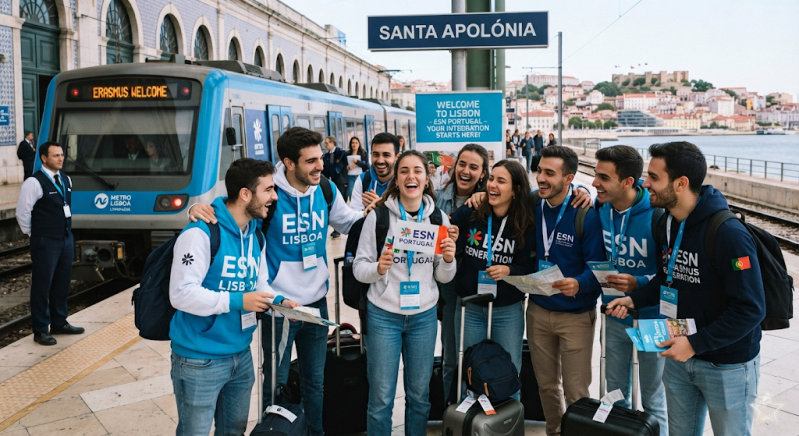
Integration, Transportation & ESN Portugal
1. Legalization of Residence (Heavy Bureaucracy)
Here the roads diverge completely depending on your passport, and Portugal is extremely strict with deadlines.
If you are an EU/EEA citizen:
- What is CRUE? Certificado de Registo de Cidadão da União. It is basically proof that you have the right to live there for more than 3 months.
- Where do you go? At the Câmara Municipal (Local City Hall) in the city where you live.
- Deadline: You have 4 months from entering the country. Don't leave it to the last few hundred meters.
- Cost: It costs around €15.
- Required documents (in addition to what is written in the guide): Valid passport/ID Card, proof of enrollment at university (Matrícula) and, be careful, proof of address in Portugal (rental contract registered with ANA/Finanças or a statement from the Junta de Freguesia – neighborhood council).
If you are a Non-EU citizen (Survival Mode):
- D4 -> AIMA Transition: The D4 visa obtained from your country of origin only gives you the right to enter Portugal and a temporary validity (usually 4 months). To stay legally for the entire year(s) of study, you need an Autorização de Residência (biometric permit) from AIMA (formerly SEF).
- Time Issue: The guide mentions waiting times of 2-5 months. The reality on the ground can be even tougher due to the huge volume of files.
- Strategy: When you receive your D4 visa from the embassy, check if you have already printed a link or a date/time for your appointment at AIMA on it. If you don't, the second you step foot in Portugal you have to call or go to their platform to block an appointment.
- Fine/Illegality: If your visa expires and you don't even have proof of your appointment at AIMA, you are illegal and risk huge problems at university and at the border.
2. Subsidized Transport (How to save hundreds of euros)
Public transport in Portugal is excellent, but if you pay for each ticket, it will drain your pocket. As a student, you have massive discounts (often up to 100% or extremely cheap subscriptions).
In Lisbon (Navegante System):
- Physical card: You have to get your Navegante card personalized (the one with a photo). Do not use the cardboard cards that are rechargeable for tourists.
- Where do you get it? At the dedicated offices in the major metro stations (e.g. Marquês de Pombal, Campo Grande). There is the option of "emergency regime" (you get it on the spot or the next day for a cost of ~€12) or normal regime (a few days, ~€6).
- "Under 23" discount: To activate the student discount (up to 23 or 24 years old, depending on the 2026 criteria), you need a special form stamped by the secretariat of your faculty in Portugal (Declaração para passe sub23). Without this form, your student rate will not be approved.
In Porto (Andante System):
- It works on exactly the same principle. Go to a Loja Andante (e.g. at Trindade or Casa da Música stations) with your proof of university and your ID/passport to create your Andante Gold under 23 card.
3. Portuguese Language (Invisible Barrier)
The guide clearly states: although the courses are in English, for bureaucracy and everyday life you need A1/B1.
- Why? Officials at Finanças (for NIF), those at the City Hall (for CRUE) or doctors at public hospitals (SNS) often refuse or do not know how to speak English. They do not necessarily do it out of malice, but administrative law forces them to fill out everything in Portuguese.
- Practical tip: In the first few weeks when you go to institutions, use the ESN Buddy system (mentioned in Step 5). Take a local student with you. It will save you hours of frustration and mistranslations on Google Translate.
For Non-EU Students (D4 Study Visa and Residence Permit)
After arrival in Portugal, the management of the right of residence, appointments and biometric permits are the responsibility of AIMA (Agência para a Integração, Migrações e Asilo). The official guide to procedures and assistance for immigrants is centralized on the single platform of the Portuguese state Portal gov.pt - Linha de Apoio, and document renewals or direct appointments are accessed through the dedicated section Portal gov.pt - Renovar Residência


For EU/EEA Students (CRUE Certificate)
Certificado de Registo de Cidadão da União Europeia (CRUE) is requested physically directly from the city hall of the city where you live (Câmara Municipal). As an example of an official flow, you can consult the digital citizen platform of the Porto City Hall: Portal do Munícipe - Porto (CRUE).

The ESN Portugal (Erasmus Student Network) organization
Is the largest network of student volunteers in the country. It operates as a non-profit, officially recognized umbrella organization that supports the integration of international young people arriving through mobility programs (Erasmus+, full degrees or other cultural exchanges).
Here is the official structure, operating mechanisms and resources of the network:
1. Structure and Local Sections
ESN Portugal acts at a federal level, being composed of local sections opened in the major university centers. Each section is directly linked to the universities in the region and collaborates with the international relations offices (DRI) of the faculties.
- National Coverage: The network includes local associations in key cities: ESN Lisboa, ESN Porto, ESN Coimbra, ESN Minho (Braga/Guimarães), ESN Aveiro, ESN Évora, ESN Covilhã, ESN UTAD (Vila Real) and ESN Algarve (Faro).
- Volunteering: All members are local students (volunteers) who know the academic system and bureaucracy of the respective city.
2. The “Buddy” Program (Mentoring System)
It is the first digital and physical point of contact for a foreign student, often activated before he/she leaves his/her home country.
- Mechanism: The international student fills out an application form on the local ESN platform of the host university. The algorithm or coordinators match the student with a “Buddy” (a local mentor), usually from the same faculty or with similar interests.
- Practical Assistance: The mentor provides direct support for airport/train pick-up, guidance in finding temporary or permanent housing and linguistic assistance at public institutions (e.g. city hall for CRUE or banks).
3. ESN Card (ESNcard) and Official Partnerships
ESNcard is the membership status of the international network and provides access to an ecosystem of commercial and logistical discounts designed to reduce the costs of a year of study abroad.
- Purchase: It is obtained physically from the headquarters of the local ESN section in the city where you study, after completing the digital profile.
- Important Logistical Benefits:
- Air Transport: The historic partnership with Ryanair (discount percentages on flights and free checked baggage for a limited number of trips).
- Accommodation: Discounts on booking fees on verified platforms such as Uniplaces or HousingAnywhere.
- Land Transport: Discounts on coach travel through European networks (e.g. FlixBus).
4. Integration, Culture and Mental Health
Beyond logistical support, the association aims to prevent the social isolation of international students through structured activities:
- Welcome Weeks: Orientation weeks at the beginning of each semester (city tours, networking events, presentations of local rules).
- Subsidized Cultural Trips: Organized excursions in historical regions of Portugal (Sintra, Algarve, Douro, Guimarães) at affordable prices for students.
- Social Causes and Inclusion: Ecological volunteering projects, blood donation or social integration activities, aligned with the values of the European Union.
To register for the mentoring program or to contact the section specific to your city, you can access the central platform ESN Portugal.
