

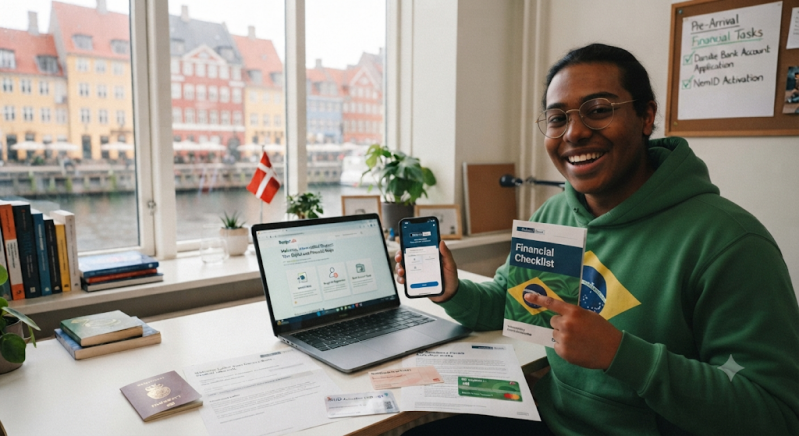
Digital & Financial Pre-Arrival Kit
Denmark is a completely cashless society. Traditional Danish banks (like Danske Bank) can take over a month to open a local account after you get your CPR number.
- Pre-Arrival Banking: Do not carry large amounts of cash. Open a digital multi-currency account beforehand to securely hold Danish Krone (DKK), settle your rental deposit, and pay for daily expenses without massive exchange losses.
- Instant Internet Setup: You will need maps and translation apps active the second you land. Order a digital European eSIM data plan to stay online during your first crucial weeks.
- Student Work Rights: While EU students can work unlimited hours, Non-EU students are legally allowed to work part-time up to 90 hours per month during the semester, and full-time during Jun
Pre-Arrival Banking
Do not carry large amounts of cash. Open a digital multi-currency account beforehand to securely hold Danish Krone (DKK), settle your rental deposit, and pay for daily expenses without massive exchange losses.
- Danish bureaucracy: A traditional bank will not open an account for you without a CPR number and MitID. Obtaining a CPR takes 2-3 weeks, and approval of the bank account takes another 2-4 weeks. In the first month, the student does not have a Danish account.
- (Wise & Revolut): Both platforms allow opening an account remotely, before departure.
- Wise is essential because it offers students the possibility to open a balance directly in Danish Krone (DKK), with a dedicated IBAN, you receive a European IBAN from the SEPA area (starting with BE - Belgium or DE - Germany), but which is technically configured to be able to hold, receive and send Danish Krone (DKK) directly. This way, they can transfer the money for the accommodation deposit (which must be paid in DKK) with the lowest exchange rates on the market.
- Revolut is perfect for daily expenses at the supermarket or transport, offering instant payments via Apple Pay / Google Pay as soon as they land.
Once the student receives the CPR number and the MitID application, he must go to a local traditional bank (e.g. Danske Bank, Nordea, Lunar) to open a 100% Danish account, which he must declare as a NemKonto for his salary or SU scholarship.
Wise
Is essential because it offers students the possibility to open a balance directly in Danish Krone (DKK), with a dedicated IBAN, you receive a European IBAN from the SEPA area (starting with BE - Belgium or DE - Germany), but which is technically configured to be able to hold, receive and send Danish Krone (DKK) directly. This way, they can transfer the money for the accommodation deposit (which must be paid in DKK) with the lowest exchange rates on the market

Revolut
Is perfect for daily expenses at the supermarket or transport, offering instant payments via Apple Pay / Google Pay as soon as they land.

Instant Internet Setup
You will need maps and translation apps active the second you land. Order a digital European eSIM data plan to stay online during your first crucial weeks.
In Denmark, public Wi-Fi networks often require a local phone number or social media login, making it difficult to access upon arrival.
- Local card issue: Danish physical operators (YouSee, Telenor) do not issue subscriptions or SIM cards without a CPR number. The only physical option is prepaid cards from supermarkets (Lebara / Lycamobile), but they require activation and a passport.
- (Airalo, Nomad, Holafly): A regional data eSIM (Europe Plan) purchased through your link is activated instantly upon landing at Copenhagen (Kastrup) or Billund airport. The student keeps their home WhatsApp number, but has instant 4G/5G internet for Google Maps (to find accommodation) and Rejseplanen (the official public transport app).
The virtual eSIM card from Airalo can be purchased exclusively online by clicking the ''Buy now eSIM Airalo Denmark'' button
Airalo
The largest global eSIM provider. For Denmark, students can choose the local package or the regional "Eurolink" package (valid throughout the European Union). Perfect if the student has a layover or travels through other EU countries. The virtual eSIM card from Airalo can be purchased exclusively online by clicking the ''Buy now eSIM Airalo Denmark'' button

Nomad
Known for being extremely affordable for large data packages (many GB at low prices). It is preferred by students who know they will use a lot of YouTube, TikTok, or maps in the first few days

Holafly
Best for Heavy Users, as it offers completely unlimited data across Denmark and Europe. It's more expensive, but students buy it because they don't want to have to worry about running out of internet in the middle of the month.

Student Work Rights (Education and Conversion)
Working while studying is a highly sought-after topic. Here you provide pure value through strict legislative details:
- EU students: They have unlimited right to work, but Danish law offers them a huge incentive called SU (Statens Uddannelsesstøtte) – a government grant of around 7,000 DKK/month (approx. 930 EUR), if the EU student works a minimum of 10-12 hours per week. Your guide should mention this, as it is the main reason why EU students look for jobs!
- Non-EU students: Much stricter rules. The ST1 residence permit gives them the right to work a maximum of 90 hours per month (on average 22 hours/week) during semesters, and full-time in the months of June, July and August. Exceeding these hours leads to the cancellation of the visa and deportation.
- Fintech connection: In order to be legally paid by the Danish employer, students need a bank account. Until their account is approved at the traditional bank, digital accounts (such as Wise with compatible IBAN) can be used to avoid delaying the receipt of their first salary.
EU students: They have unlimited right to work, but Danish law offers them a huge incentive called SU (Statens Uddannelsesstøtte)

Non-EU students: Much stricter rules. The ST1 residence permit gives them the right to work a maximum of 90 hours per month (on average 22 hours/week) during semesters, and full-time in the months of June, July and August. Exceeding these hours leads to the cancellation of the visa and deportation.
