

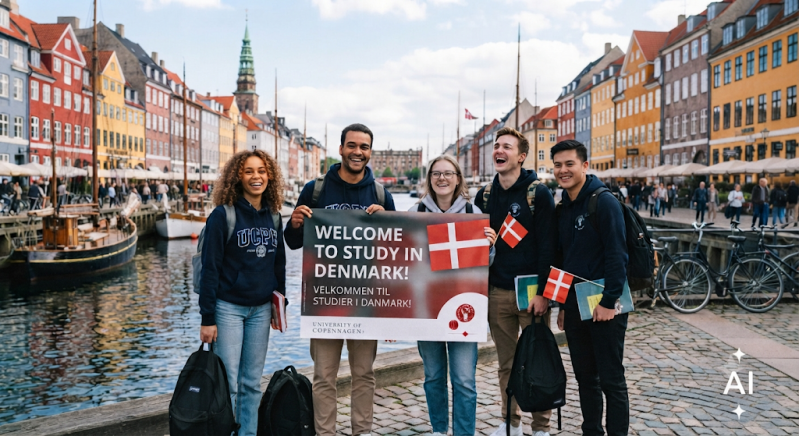
Moving to Denmark is an incredible opportunity, but the administrative maze can be overwhelming. This centralized guide breaks down every single step you need to take before and after arriving in the Kingdom of Denmark, whether you are an EU citizen or an International (Non-EU) student.
Road Map
Step 1
University Admission & Legal Entry (EU vs. Non-EU)
Your legal route to Denmark depends entirely on your passport. Do not mix up these requirements, as deadlines are non-negotiable.
- For EU/EEA Citizens: You do not need a visa to enter. Once you arrive, you must register with SIRI (Danish Agency for International Recruitment and Integration) to get your official EU Residence Document (EU-opholdsdokument).
- For Non-EU International Students: You must apply for and receive your Residence Permit (ST1 Visa) BEFORE traveling to Denmark. Your university will initiate this process right after you pay your tuition fees. You will also need to provide biometrics (fingerprints and photo) at a local Danish embassy/visa center.
Step 2
Securing Your Student Accommodation ("No Visa, No Pay")
Finding housing in major cities like Copenhagen, Aarhus, or Odense is fierce and highly competitive. Rent fraud is very common on social media, so you must rely on vetted platforms.
- Student Housing (Kollegier): Apply early through central regional platforms like KKIK (Copenhagen) or Student Housing Aarhus.
- The "No Visa, No Pay" Protection: If you are a Non-EU student renting through professional private providers, always look for the "No Visa, No Pay" clause. This guarantees that if your Danish ST1 residence permit is rejected, your accommodation housing deposit will be fully refunded.
- The Deposit: Landlords can legally ask for up to 3 months of rent as a deposit. Never transfer money before a Danish lease contract (Lejekontrakt) is signed by both sides.
Step 3
Getting Your CPR Number & MitID
Regardless of your country of origin, you cannot live in Denmark without a CPR Number (Civil Registration Number). You must register with the local municipality (Folkeregistret) within 5 days of arriving.
- The CPR Number: This single number unlocks everything—free public healthcare, local phone numbers, student jobs, and traditional bank setups.
- The Yellow Health Card (Sundhedskort): This card acts as your national health insurance. Crucial for Non-EU students: Because your public healthcare only starts after your CPR is issued, you must secure private health insurance to cover your first few weeks in Denmark.
- MitID: The official secure digital ID app. You will use MitID to sign contracts, access digital banking, and read official letters from the government.
Step 4
Digital & Financial Pre-Arrival Kit
Denmark is a completely cashless society. Traditional Danish banks (like Danske Bank) can take over a month to open a local account after you get your CPR number.
- Pre-Arrival Banking: Do not carry large amounts of cash. Open a digital multi-currency account beforehand to securely hold Danish Krone (DKK), settle your rental deposit, and pay for daily expenses without massive exchange losses.
- Instant Internet Setup: You will need maps and translation apps active the second you land. Order a digital European eSIM data plan to stay online during your first crucial weeks.
- Student Work Rights: While EU students can work unlimited hours, Non-EU students are legally allowed to work part-time up to 90 hours per month during the semester, and full-time during Jun
Step 5
Join the Community & Student Support (ESN Denmark)
Social integration is just as important as your paperwork. Connecting with international networks is the fastest way to fight culture shock, make friends, and adapt to Danish life.
1. ESN Denmark: The Erasmus Student Network operates active local chapters across all major university cities (Copenhagen, Aarhus, Odense, Aalborg), supporting both EU and Non-EU international students.
- The ESNcard: Make sure to secure your official ESNcard immediately upon arrival. It is your ultimate ticket to international student events, local welcome parties, and massive discounts across Europe (including special perks for Ryanair flights and FlixBus routes).
[BUTTON in Webador] Text: "Connect with ESN Denmark" -> Link to: https://esndenmark.org
In addition to ESN, in Denmark the student union structure is extremely well developed and represents a huge integration opportunity for students (both EU and Non-EU).
Here are the most important organizations and associations in Denmark that you can add to your guide, structured exactly according to the logic of your platform:
2. Student unions
Every major university in Denmark has a central student association (the equivalent of a student union). They are completely legal, have huge budgets and organize weekly events.
- Studenterrådet (The Student Council) — There are at the University of Copenhagen (KU), Aarhus University (AU) and the University of Southern Denmark (SDU). They are the largest organizations. They defend students' rights, organize concerts, opening festivals and job fairs.
- PF (Polyteknisk Forening) — The student association at DTU (Technical University of Denmark), extremely strong for engineers and technical students.
3. The Friday Bars (Fredagsbar) – Danish Cultural Specifics
This is the most important opportunity for social integration in Denmark. Each faculty/department has its own bar or space where every Friday volunteers (students) sell beer and soft drinks at very low prices for students.
- It is the main place where international students make friends with Danish students.
- They are run exclusively by volunteer associations within the faculties.
4. Career and Business Organizations (International)
For students who want to find a part-time job in Denmark (especially essential for Non-EU who have limited work rights), these organizations offer business networking:
- AIESEC Denmark — Present in major cities (Copenhagen, Aarhus). Helps students with internships, global volunteering and developing leadership skills.
- Danish Students Abroad (DSA) — Although focused on expatriate Danes, their local network offers support and cultural exchanges for international communities.
5. Studenterhuset (The Student House)
In the big cities (Copenhagen, Aarhus, Odense, Aalborg) there is a “Studenterhuset” – a huge café/cultural center owned by non-profit student associations.
- It is a cultural hub where students can go to study, drink cheap coffee, play board games or participate in international quiz nights.
- Opportunity: Students can sign up as volunteers at the bar or organizing events, which is the fastest way to get local connections.
- Daily Life & Essentials: Moving to a new country comes with a host of practical needs for everyday life. From essential pharmaceuticals and personal care items to seasonal clothes and university outfits, you can get everything quickly and online, with delivery directly to your new address.
STEP 1
University Admission & Legal Entry (EU vs. Non-EU)
Your legal route to Denmark depends entirely on your passport. Do not mix up these requirements, as deadlines are non-negotiable.
- For EU/EEA Citizens: You do not need a visa to enter. Once you arrive, you must register with SIRI (Danish Agency for International Recruitment and Integration) to get your official EU Residence Document (EU-opholdsdokument).
- For Non-EU International Students: You must apply for and receive your Residence Permit (ST1 Visa) BEFORE traveling to Denmark. Your university will initiate this process right after you pay your tuition fees. You will also need to provide biometrics (fingerprints and photo) at a local Danish embassy/visa center.

STEP 2
Securing Your Student Accommodation ("No Visa, No Pay")
Finding housing in major cities like Copenhagen, Aarhus, or Odense is fierce and highly competitive. Rent fraud is very common on social media, so you must rely on vetted platforms.
- Student Housing (Kollegier): Apply early through central regional platforms like KKIK (Copenhagen) or Student Housing Aarhus.
- The "No Visa, No Pay" Protection: If you are a Non-EU student renting through professional private providers, always look for the "No Visa, No Pay" clause. This guarantees that if your Danish ST1 residence permit is rejected, your accommodation housing deposit will be fully refunded.
- The Deposit: Landlords can legally ask for up to 3 months of rent as a deposit. Never transfer money before a Danish lease contract (Lejekontrakt) is signed by both sides.
1. Early booking: A non-EU student finds his room in Copenhagen or Aarhus in May/June.
2. Deposit payment: To lock the room, he has to pay the deposit and the first month's rent (often a large amount, between 1,500 and 3,000 EUR).
3. Visa process (ST1): Afterwards, he applies to SIRI for a residence permit. The process can take up to 2-3 months.
4. Activation of the clause: If the visa is rejected or delayed so much that the student misses the academic year, he sends the official proof of rejection from SIRI to the accommodation operator, who is contractually obliged to return 100% of the money paid, without penalties.
Who offers this clause in Denmark?
Not all entities offer this. Private owners on Facebook or small classifieds sites will never return the money. Therefore, students should use the large private student accommodation operators (PBSA - Purpose-Built Student Accommodation),
- BaseCamp Student (Present in Copenhagen, South Campus and Lyngby) — They are one of the largest premium operators in Denmark. They have a very clear official "No Visa, No Pay" policy for international students.
- Unity Living / Unity Aarhus (Copenhagen) — Modern student studios that offer contractual flexibility and cancellation policies in case of visa refusal.
- Global booking platforms (e.g. AmberStudent) — These are large accommodation directories (aggregators). They have partnerships with almost all operators in Denmark and you can directly check the "No Visa, No Pay" filter.
"The Deposit Warning"
In Denmark, the rental law (Lejeloven) allows landlords to ask for:
- Up to 3 months rent as a deposit (the money that remains as a guarantee for damages).
- Up to 3 months rent paid in advance (rent covering the last months of the contract, when the student announces that they are leaving).
- Plus the first month of current rent.
This means that a student can find themselves being asked for up to 7 months rent in advance when signing the contract! For large companies (BaseCamp, Unity) it is a standard and safe procedure. However, if a private landlord on the internet asks for this money via direct bank transfer (without a signed contract with MitID or without a secure platform like BoligPortal), it is 99% a fraud.
Student Housing (Kollegier): Apply early through central regional platforms like KKIK (Copenhagen) or Student Housing Aarhus.

BaseCamp Student (Present in Copenhagen, South Campus and Lyngby) — They are one of the largest premium operators in Denmark. They have a very clear official "No Visa, No Pay" policy for international students.

Unity Living / Unity Aarhus (Copenhagen) — Modern student studios that offer contractual flexibility and cancellation policies in case of visa refusal.


Global booking platforms (e.g. AmberStudent) — These are large accommodation directories (aggregators). They have partnerships with almost all operators in Denmark and you can directly check the "No Visa, No Pay" filter.

STEP 3
Getting Your CPR Number & MitID
Regardless of your country of origin, you cannot live in Denmark without a CPR Number (Civil Registration Number). You must register with the local municipality (Folkeregistret) within 5 days of arriving.
- The CPR Number: This single number unlocks everything—free public healthcare, local phone numbers, student jobs, and traditional bank setups.
- The Yellow Health Card (Sundhedskort): This card acts as your national health insurance. Crucial for Non-EU students: Because your public healthcare only starts after your CPR is issued, you must secure private health insurance to cover your first few weeks in Denmark.If you want to compare other options or are looking for other flexible travel/medical plans that comply with visa requirements, you can also use HelloSafe — a global comparator that allows you to quickly analyze various insurance offers tailored for international students.
- MitID: The official secure digital ID app. You will use MitID to sign contracts, access digital banking, and read official letters from the government.
Digital Comparator HelloSafe
- Anonymity: Users can view policy rates and features instantly without entering a phone number or email address.
- Regulatory Compliance: Operates under a certified financial product brokerage license valid throughout Europe.
- Partner Network: Sources data directly from major insurance groups, niche brokers, and traditional financial institutions

The CPR Number: This single number unlocks everything—free public healthcare, local phone numbers, student jobs, and traditional bank setups.

The Yellow Health Card (Sundhedskort): This card acts as your national health insurance. Crucial for Non-EU students: Because your public healthcare only starts after your CPR is issued, you must secure private health insurance to cover your first few weeks in Denmark.

MitID: The official secure digital ID app. You will use MitID to sign contracts, access digital banking, and read official letters from the government.

STEP 4
Digital & Financial Pre-Arrival Kit
Denmark is a completely cashless society. Traditional Danish banks (like Danske Bank) can take over a month to open a local account after you get your CPR number.
- Pre-Arrival Banking: Do not carry large amounts of cash. Open a digital multi-currency account beforehand to securely hold Danish Krone (DKK), settle your rental deposit, and pay for daily expenses without massive exchange losses.
- Instant Internet Setup: You will need maps and translation apps active the second you land. Order a digital European eSIM data plan to stay online during your first crucial weeks.
- Student Work Rights: While EU students can work unlimited hours, Non-EU students are legally allowed to work part-time up to 90 hours per month during the semester, and full-time during Jun
Pre-Arrival Banking
Do not carry large amounts of cash. Open a digital multi-currency account beforehand to securely hold Danish Krone (DKK), settle your rental deposit, and pay for daily expenses without massive exchange losses.
- Danish bureaucracy: A traditional bank will not open an account for you without a CPR number and MitID. Obtaining a CPR takes 2-3 weeks, and approval of the bank account takes another 2-4 weeks. In the first month, the student does not have a Danish account.
- (Wise & Revolut): Both platforms allow opening an account remotely, before departure.
- Wise is essential because it offers students the possibility to open a balance directly in Danish Krone (DKK), with a dedicated IBAN, you receive a European IBAN from the SEPA area (starting with BE - Belgium or DE - Germany), but which is technically configured to be able to hold, receive and send Danish Krone (DKK) directly. This way, they can transfer the money for the accommodation deposit (which must be paid in DKK) with the lowest exchange rates on the market.
- Revolut is perfect for daily expenses at the supermarket or transport, offering instant payments via Apple Pay / Google Pay as soon as they land.
Once the student receives the CPR number and the MitID application, he must go to a local traditional bank (e.g. Danske Bank, Nordea, Lunar) to open a 100% Danish account, which he must declare as a NemKonto for his salary or SU scholarship.
Wise
Is essential because it offers students the possibility to open a balance directly in Danish Krone (DKK), with a dedicated IBAN, you receive a European IBAN from the SEPA area (starting with BE - Belgium or DE - Germany), but which is technically configured to be able to hold, receive and send Danish Krone (DKK) directly. This way, they can transfer the money for the accommodation deposit (which must be paid in DKK) with the lowest exchange rates on the market

Revolut
Is perfect for daily expenses at the supermarket or transport, offering instant payments via Apple Pay / Google Pay as soon as they land.

Instant Internet Setup
You will need maps and translation apps active the second you land. Order a digital European eSIM data plan to stay online during your first crucial weeks.
In Denmark, public Wi-Fi networks often require a local phone number or social media login, making it difficult to access upon arrival.
- Local card issue: Danish physical operators (YouSee, Telenor) do not issue subscriptions or SIM cards without a CPR number. The only physical option is prepaid cards from supermarkets (Lebara / Lycamobile), but they require activation and a passport.- (Airalo, Nomad, Holafly): A regional data eSIM (Europe Plan) purchased through your link is activated instantly upon landing at Copenhagen (Kastrup) or Billund airport. The student keeps their home WhatsApp number, but has instant 4G/5G internet for Google Maps (to find accommodation) and Rejseplanen (the official public transport app).
The virtual eSIM card from Airalo can be purchased exclusively online by clicking the ''Buy now eSIM Airalo Denmark'' button
Airalo
The largest global eSIM provider. For Denmark, students can choose the local package or the regional "Eurolink" package (valid throughout the European Union). Perfect if the student has a layover or travels through other EU countries

Nomad
Known for being extremely affordable for large data packages (many GB at low prices). It is preferred by students who know they will use a lot of YouTube, TikTok, or maps in the first few days

Holafly
Best for Heavy Users, as it offers completely unlimited data across Denmark and Europe. It's more expensive, but students buy it because they don't want to have to worry about running out of internet in the middle of the month.

Student Work Rights (Education and Conversion)
Working while studying is a highly sought-after topic. Here you provide pure value through strict legislative details:
- EU students: They have unlimited right to work, but Danish law offers them a huge incentive called SU (Statens Uddannelsesstøtte) – a government grant of around 7,000 DKK/month (approx. 930 EUR), if the EU student works a minimum of 10-12 hours per week. Your guide should mention this, as it is the main reason why EU students look for jobs!
- Non-EU students: Much stricter rules. The ST1 residence permit gives them the right to work a maximum of 90 hours per month (on average 22 hours/week) during semesters, and full-time in the months of June, July and August. Exceeding these hours leads to the cancellation of the visa and deportation.
- Fintech connection: In order to be legally paid by the Danish employer, students need a bank account. Until their account is approved at the traditional bank, digital accounts (such as Wise with compatible IBAN) can be used to avoid delaying the receipt of their first salary.
EU students: They have unlimited right to work, but Danish law offers them a huge incentive called SU (Statens Uddannelsesstøtte)

Non-EU students: Much stricter rules. The ST1 residence permit gives them the right to work a maximum of 90 hours per month (on average 22 hours/week) during semesters, and full-time in the months of June, July and August. Exceeding these hours leads to the cancellation of the visa and deportation.

STEP 5
Join the Community & Student Support (ESN Denmark)
Social integration is just as important as your paperwork. Connecting with international networks is the fastest way to fight culture shock, make friends, and adapt to Danish life.
1. ESN Denmark: The Erasmus Student Network operates active local chapters across all major university cities (Copenhagen, Aarhus, Odense, Aalborg), supporting both EU and Non-EU international students.
- The ESNcard: Make sure to secure your official ESNcard immediately upon arrival. It is your ultimate ticket to international student events, local welcome parties, and massive discounts across Europe (including special perks for Ryanair flights and FlixBus routes).
In addition to ESN, in Denmark the student union structure is extremely well developed and represents a huge integration opportunity for students (both EU and Non-EU).
Here are the most important organizations and associations in Denmark
2. Student unions
Every major university in Denmark has a central student association (the equivalent of a student union). They are completely legal, have huge budgets and organize weekly events.
- Studenterrådet (The Student Council) — There are at the University of Copenhagen (KU), Aarhus University (AU) and the University of Southern Denmark (SDU). They are the largest organizations. They defend students' rights, organize concerts, opening festivals and job fairs.
- PF (Polyteknisk Forening) — The student association at DTU (Technical University of Denmark), extremely strong for engineers and technical students.
3. The Friday Bars (Fredagsbar) – Danish Cultural Specifics
This is the most important opportunity for social integration in Denmark. Each faculty/department has its own bar or space where every Friday volunteers (students) sell beer and soft drinks at very low prices for students.
- It is the main place where international students make friends with Danish students.
- They are run exclusively by volunteer associations within the faculties.
4. Career and Business Organizations (International)
For students who want to find a part-time job in Denmark (especially essential for Non-EU who have limited work rights), these organizations offer business networking:
- AIESEC Denmark — Present in major cities (Copenhagen, Aarhus). Helps students with internships, global volunteering and developing leadership skills.
- Danish Students Abroad (DSA) — Although focused on expatriate Danes, their local network offers support and cultural exchanges for international communities.
5. Studenterhuset (The Student House)
In the big cities (Copenhagen, Aarhus, Odense, Aalborg) there is a “Studenterhuset” – a huge café/cultural center owned by non-profit student associations.
- It is a cultural hub where students can go to study, drink cheap coffee, play board games or participate in international quiz nights.
- Opportunity: Students can sign up as volunteers at the bar or organizing events, which is the fastest way to get local connections.
ESN Denmark
The Erasmus Student Network operates active local chapters across all major university cities (Copenhagen, Aarhus, Odense, Aalborg), supporting both EU and Non-EU international students.
- The ESNcard: Make sure to secure your official ESNcard immediately upon arrival. It is your ultimate ticket to international student events, local welcome parties, and massive discounts across Europe (including special perks for Ryanair flights and FlixBus routes).

Student unions
Every major university in Denmark has a central student association (the equivalent of a student union). They are completely legal, have huge budgets and organize weekly events.
Studenterrådet (The Student Council) — There are at the University of Copenhagen (KU), Aarhus University (AU) and the University of Southern Denmark (SDU). They are the largest organizations. They defend students' rights, organize concerts, opening festivals and job fairs.

- PF (Polyteknisk Forening) — The student association at DTU (Technical University of Denmark), extremely strong for engineers and technical students.

The Friday Bars (Fredagsbar) – Danish Cultural Specifics
This is the most important opportunity for social integration in Denmark. Each faculty/department has its own bar or space where every Friday volunteers (students) sell beer and soft drinks at very low prices for students.
- It is the main place where international students make friends with Danish students.
- They are run exclusively by volunteer associations within the faculties.

Career and Business Organizations (International)
For students who want to find a part-time job in Denmark (especially essential for Non-EU who have limited work rights), these organizations offer business networking:
AIESEC Denmark
Present in major cities (Copenhagen, Aarhus). Helps students with internships, global volunteering and developing leadership skills.

Danish Students Abroad
(DSA) Although focused on expatriate Danes, their local network offers support and cultural exchanges for international communities.

Studenterhuset (The Student House)
In the big cities (Copenhagen, Aarhus, Odense, Aalborg) there is a “Studenterhuset” – a huge café/cultural center owned by non-profit student associations.
- It is a cultural hub where students can go to study, drink cheap coffee, play board games or participate in international quiz nights.
- Opportunity: Students can sign up as volunteers at the bar or organizing events, which is the fastest way to get local connections.
Studenterhuset Copenhagen

Studenterhus Aarhus

Studenterhuset Aalborg

Studenterhuset Odense

Health & Personal Care in Europe: PromoFarma
Setting up your new student life in a new country? PromoFarma is your go-to online marketplace for healthcare, skincare, and daily essentials. Instead of wandering through local pharmacies trying to translate labels, you can order certified wellness and personal care products online from trusted European pharmacies.
Why it is perfect for international students:
- One-Stop Shop: Access more than 150,000 personal care products, vitamins, sports nutrition, and cosmetics in one single click.
- Smart Savings: The platform automatically compares prices across hundreds of partner pharmacies to guarantee you get the best deal available.
- Effortless Delivery: No need to search the city; get your parcel delivered straight to your student apartment anywhere you are.
